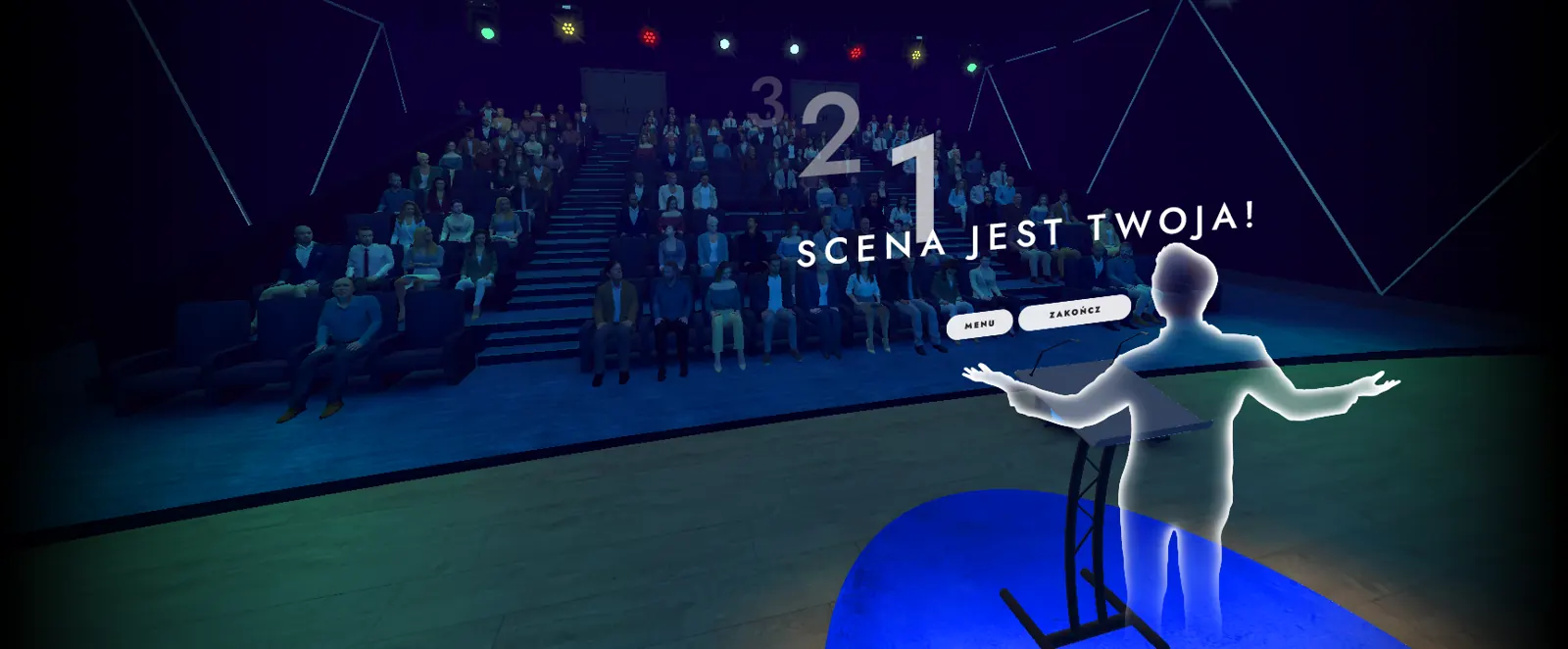
Public speaking training that teaches you to own the stage
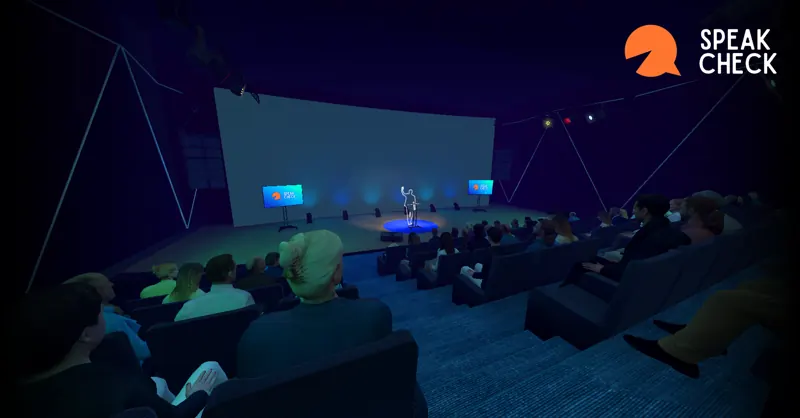
You step onto a stage in front of a virtual audience and speak against the clock, while Speak Check shows you in data how your body, gaze and voice work. The method comes from actor training, not from a corporate classroom.
- Meta Quest 3, no cables or computer
- Sessions in Polish and English
- Tested with real training participants
You already have the content. The stage is a different skill.
Managers, founders and experts know what to say. What is harder is standing steady, looking at the whole room, holding a pause and keeping your pace under pressure. You cannot rehearse that with notes in your hand — you have to step onto a stage. Ideally many times.
A repeatable stage
Every run happens in the same conditions: the same room, the same audience, the same time limit. You can see what really changes.
Data instead of impressions
Instead of "that went fine" you see who you looked at, how you used the space and where your voice faded.
A safe place to fail
Make ten mistakes before you face a real jury, board or conference hall.
VR training rests on solid evidence: a meta-analysis of 92 publications found that it significantly reduces public speaking anxiety (Current Psychology, 2022).
What a Speak Check session looks like
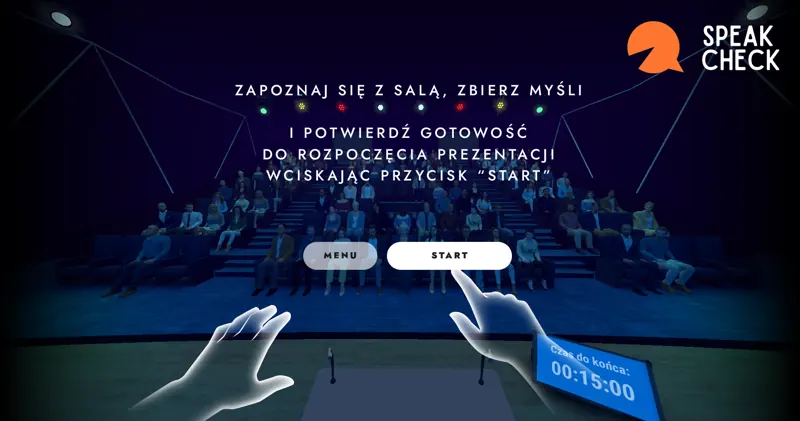
Enter the room
Look around, gather your thoughts and decide when to begin.
The stage is yours
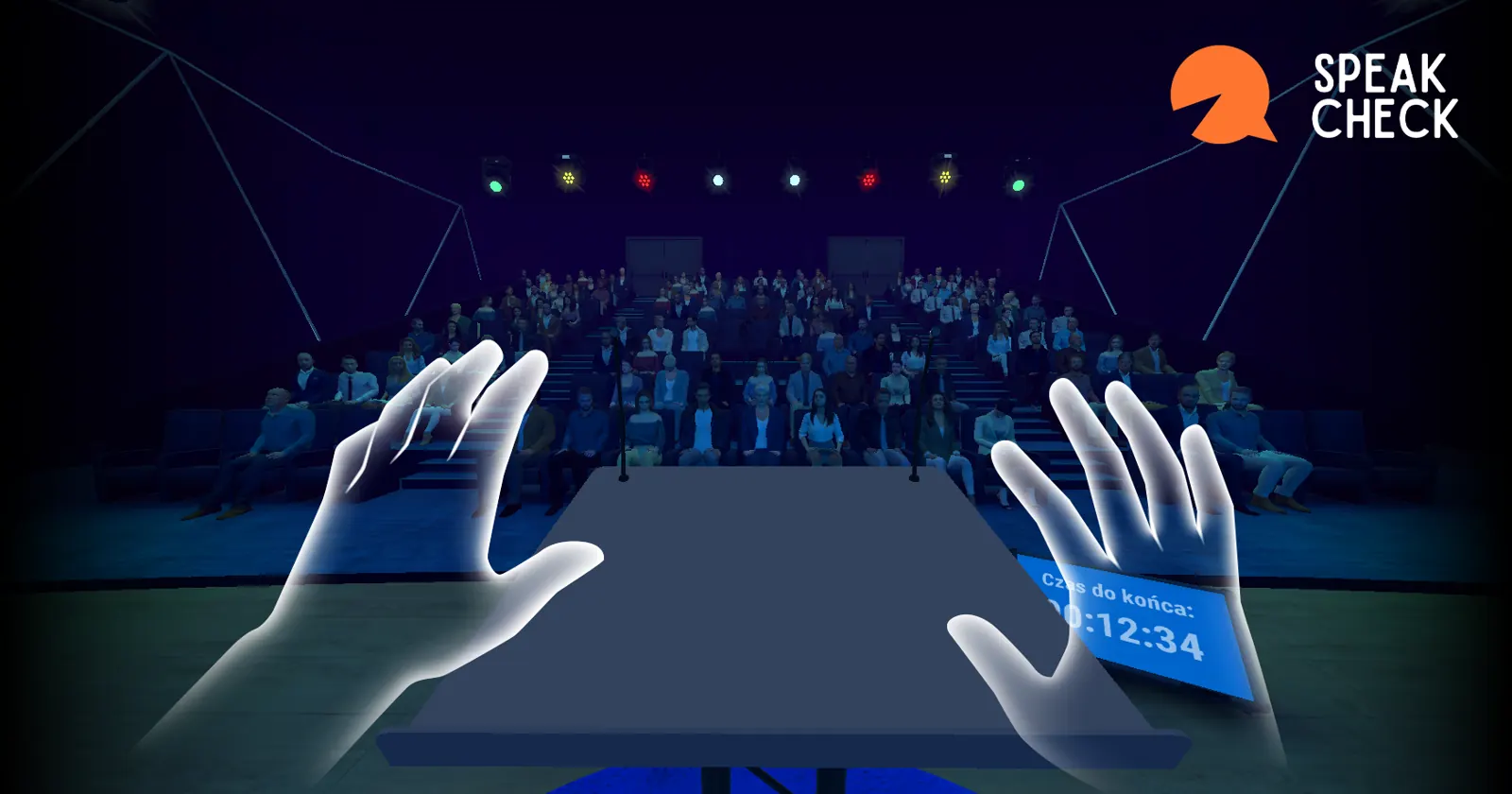
Countdown, lights, audience. You speak with a timer in view and an audience that behaves like a real one.
See the data
After the talk you see a map of audience contact, your movement on stage, gestures and pauses.
Practise and return
A trainer picks your exercises, you go back on stage and check what changed.
What Speak Check sees that a mirror does not
The headset tracks your head and hand movement and your voice. That becomes a picture of your talk you can compare with your next run.
Audience contact
How long you give each section of the room and which seats you skip. The contact heatmap is the feature test participants rated highest.
Stage movement
How you use the space: where you stand, when you move and whether you hide behind the lectern.
Gestures
The range and amount of hand movement — whether your gestures support your words or drown them out.
Pauses and pace
Where you pause on purpose, and where you rush or lose your thread.
Timing
The on-stage timer shows whether you stay within your slot or race through the ending.
Polish speech and progress
A speech model that recognises Polish filler words, a side-by-side comparison of runs and a dashboard for trainers.
The Meta Quest 3 headset does not see your face. We analyse movement and sound — we do not assess emotions.
A method straight from the theatre
We don't teach you to talk. We teach you to be on stage.
Speak Check grows out of years of a choreographer's and director's work with body, voice and space. We are bringing proven theatre exercises into VR — and giving them measurement.
That makes the training about stage presence, not only about what you say. A laptop webcam cannot measure that.
- Grounding and neutral stanceStability instead of swaying and shifting.
- Points of focusContact with the whole room, not one friendly face.
- The pause as actionSilence that works for you instead of "um".
- ViewpointsConscious use of space and distance to the audience.
- Laban movement qualitiesGestures that match your content and energy.
- StatusHow body and voice build authority on stage.
- Voice projectionA voice that carries to the back row.
Who Speak Check is for
Accelerators and incubators
Founders rehearse their pitch before demo day and face investors with data, not just hope.
Universities and business schools
Students, PhD candidates and MBA participants practise defences, presentations and conference talks.
Trainers and training companies
A measurable diagnosis at the start and an objective view of your clients' progress between sessions.
Companies and teams
Managers and experts before an all-hands, an industry conference or a board presentation.
How we can work together
We bring the hardware — you do not need your own headsets.
Pilot for institutions
A few weeks with headsets and reports for a group of participants. Try Speak Check in your setting before you decide.
Universities, accelerators, business schools
VR workshop for teams
A day with a trainer: runs on stage, reports and feedback for every participant.
Companies, accelerator programmes, conferences
One-to-one session
A diagnosis before an important talk: runs in VR and specific guidance on what to practise.
Founders, managers, speakers
Programme for trainers
An app and dashboard for working with your own clients, built on the Speak Check method.
Public speaking trainers and coaches

Founder
Speak Check is created by Dr Tomasz Ciesielski — choreographer, director and theatre researcher, certified business trainer (Kozminski University) and graduate of the Stanford GSB Executive Education programme "The Emerging COO". He co-developed a pitch preparation methodology used in training programmes for founders.
Frequently asked questions
Do I need my own VR headset?
No. For pilots, workshops and sessions we bring Meta Quest 3 kits — no cables and no computer needed.
How long is a session?
A single run usually takes a few to around fifteen minutes, with a timer visible on stage. A full session with feedback takes about an hour.
Which languages do you work in?
Polish and English.
What data do you collect?
Head and hand movement, your position on stage and the audio of your talk. The headset does not see your face and we do not assess emotions. The data is used to prepare your report.
How is Speak Check different from speech practice apps?
Phone and webcam apps mainly analyse your voice. Speak Check puts you on a stage: it measures your body in space, your contact with the whole room and how you behave under the pressure of an audience.
Can VR make me feel unwell?
Sessions are short, you stand still in a static room, and you can stop and take the headset off at any moment.
Book a pilot or demo
Tell us who you are and what you would use Speak Check for: a pitch before demo day, university classes, a leadership programme or work with your own clients.
kontakt@speakcheck.eu